
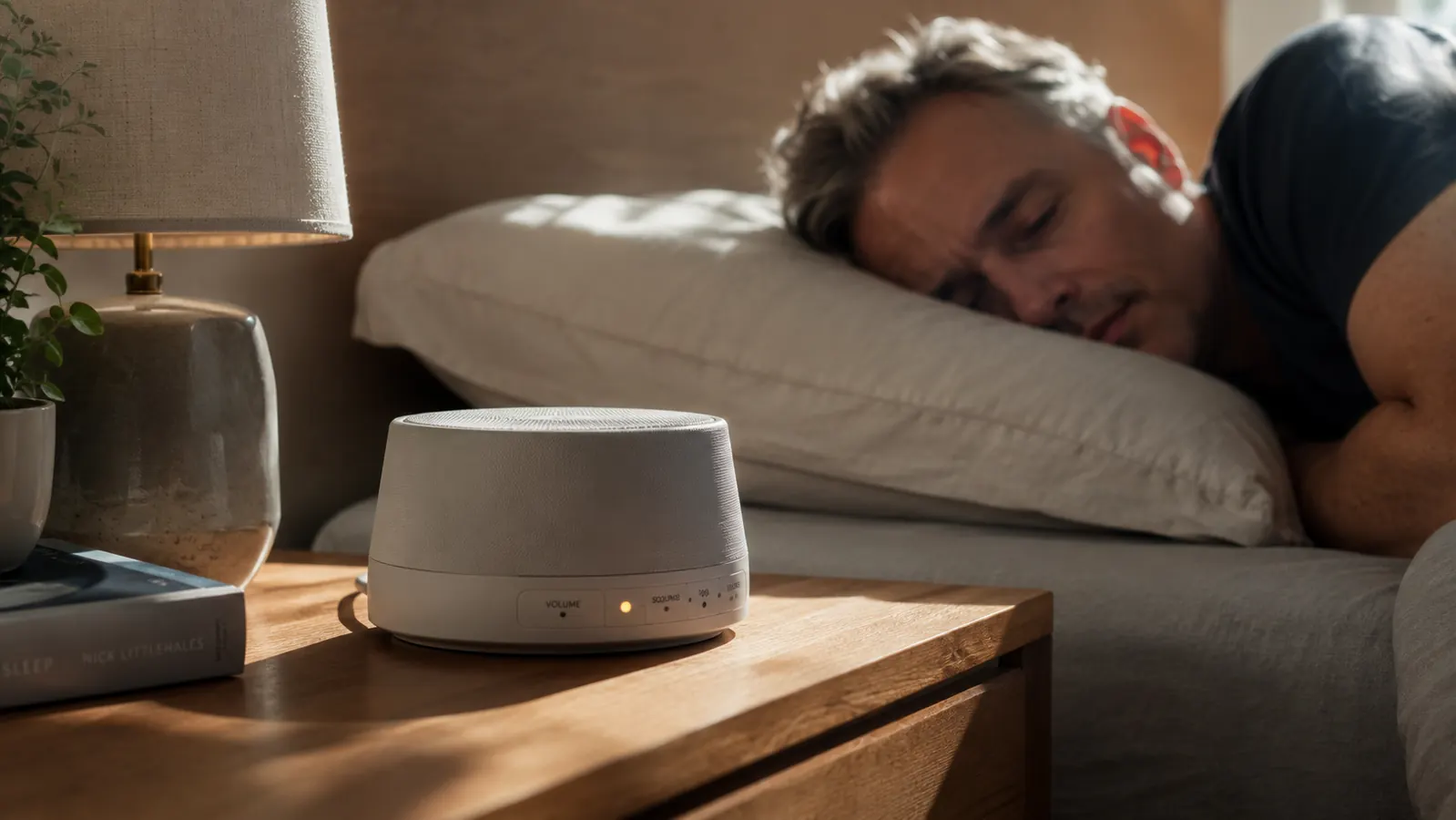
Nobody puts this in the product photos, but the little indicator light on the front of the Magicteam Sound White Noise Machine doesn't fully turn off, and in a bedroom that's already bright at 9am because I'm sleeping on a schedule nobody else keeps, a second light source is the last thing I want near my face. I spent eleven years producing an overnight radio show, which put my real sleep window somewhere between 9am and 4pm in a west-facing second-floor bedroom where the afternoon sun comes through the blinds no matter how I angle them, on a street that runs a full daytime shift of traffic the entire time I'm supposed to be asleep. I'm coming up on a year with this machine running every day, and I want to talk about the parts of it that the glowing lifestyle photos and the five-star average don't mention.
This isn't a takedown. I still use the thing nightly, or daily, depending on how you count my hours. But an honest review means starting with what actually annoyed me before I get to what worked, and there's more of the former than the marketing copy would suggest, especially once you've lived with the device long enough to stop being grateful the noise finally quieted down and start actually paying attention to the machine itself.
The Quick Verdict
A genuinely useful masking sound with a stepped volume dial that isn't as smooth as it looks, a light that never fully goes dark, and a couple of the 20 sounds that loop more obviously than the listing promises.
Amazon Check Today's Price →Before you buy, know exactly what you're getting into
The Magicteam Sound White Noise Machine still earns its spot on my nightstand after nearly a year, rough edges and all. Check today's price on Amazon and read the full list of things I wish someone had told me first.
Amazon Check Today's Price on Amazon →How We Tested
I didn't just run the machine and vibe-check it. Over several weeks I timed each of the 20 sounds with a stopwatch on my phone to see how long the loop actually runs before it repeats. I tested the volume dial in the dark with my eyes closed to see how consistently I could land on the same setting by feel alone. I plugged the included adapter into three different outlets in my bedroom, including one shared with a lamp on the same circuit, to see if the buzz I noticed was the machine or the wiring. And I logged, in a plain notes app, every single thing that made me pause and think "huh, that's not what I expected" across close to a year of daily use.
None of this is scientific in a lab sense. It's one person, one room, one specific set of noise problems. But it's a lot more scrutiny than a single unboxing video gives a product before the review goes live, and it's the kind of testing that actually surfaces the small stuff nobody mentions until you've lived with a device for months, long after the initial excitement of a quieter morning has worn off.
I've told the fuller story of how I ended up with this specific machine, including the exact morning that finally pushed me to order one, over in the longer story behind why I bought it. This piece skips the backstory and goes straight at the flaws.
The Light Nobody Mentions
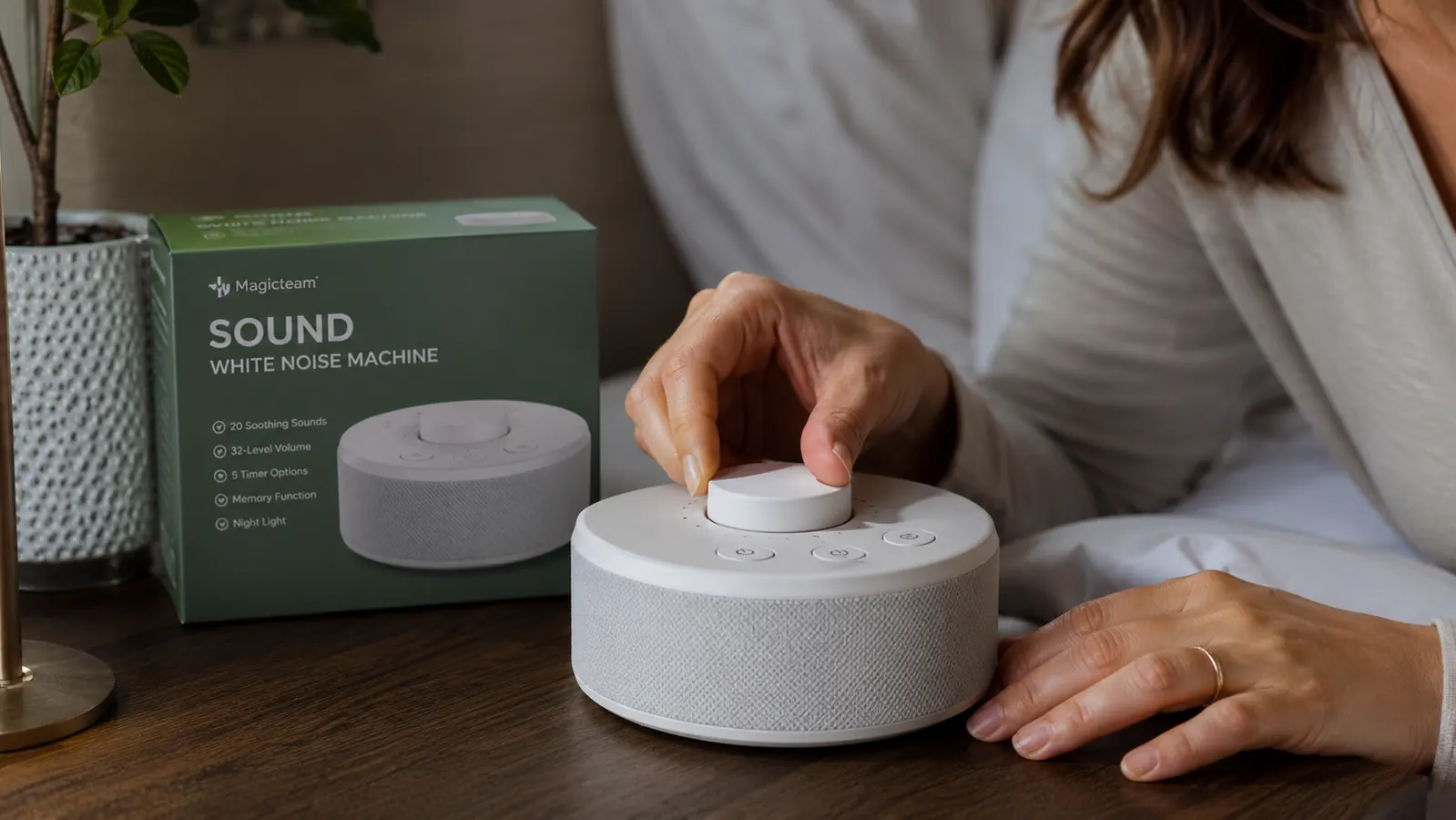
Start with the indicator light, because it's the single thing I wish I'd known before ordering. It's small, it's a soft blue, and on paper it sounds like nothing. But when your bedroom is already fighting afternoon sun through the blinds, a second light source sitting six inches from your pillow at eye level is one more thing your brain has to work around. It's not bright enough to read by. It is bright enough that on nights, or rather mornings, when I'm already struggling to get my eyes to stay shut, I notice it through closed eyelids as a faint presence rather than true dark.
There's no way to disable it that I've found in the manual or by trial and error with the buttons. Some nights I've draped a washcloth over the front panel, which works but feels like a workaround for something a budget-friendly device should just let you turn off. If you already sleep in a bright room like mine, this won't ruin the machine for you, because the sun is doing far more damage to your dark than one small LED ever will. But if your bedroom is otherwise dark and you're specifically trying to protect that, factor this in before you buy.
The Adapter Buzz Nobody Warns You About
The included power adapter is basic, and on two of the three outlets I tested it in, it introduced a faint electrical buzz underneath the sound the machine was actually playing. It's subtle enough that you might not catch it at first, especially if you're playing one of the louder nature sounds, but on the flatter white noise and fan settings I could hear it clearly once I knew to listen for it. Swapping to a third outlet, one not shared with anything else on the same circuit, made it mostly disappear, but that's a fix you have to discover yourself through trial and error, not something the packaging tells you to expect.
This is one of the real tradeoffs of a digital speaker-based machine versus something mechanical. A device that generates its sound from an actual spinning fan, like the Yogasleep Dohm I looked at before settling on this one, doesn't have a digital amplifier that can pick up electrical noise from a shared circuit in the first place. I go through that comparison in more detail in how the two machines actually differ, but the short version is that you're trading mechanical simplicity for sound variety, and the adapter buzz is part of that trade whether the listing mentions it or not.
None of this made the machine unusable in my room. It took me about ten minutes on one weekend afternoon to find the quiet outlet and settle there permanently. But it's exactly the kind of small setup annoyance that a five-star average review doesn't capture, because most people either don't notice it or don't bother writing about it once they've solved it and moved on.
The Volume Dial Isn't as Smooth as It Looks
The rotating dial photographs beautifully and feels premium under your thumb, but it moves in noticeable steps rather than a true smooth gradient. Between roughly the halfway point and three-quarters, each click of the dial jumps the volume by more than I'd like, meaning there's a real setting I want that sits somewhere between two of the actual stops the dial offers. I've settled for the lower of the two most mornings, which means I'm sleeping through slightly more traffic noise than I would if the dial let me land exactly where I wanted.
There's also a faint internal hum from the machine's own components underneath whatever sound you've selected, most audible at low volumes late at night when everything else in the house has gone quiet. It's not loud enough to be a dealbreaker, and once the actual sound is playing at a normal level it disappears into the mix entirely. But at the very low end of the volume range, where you might expect nothing but the pure quiet of your chosen sound, there's a very slight mechanical undertone that the listing photos obviously can't show you.
The Sounds Aren't All Labeled, and a Couple Actually Loop
The device itself doesn't display sound names, just numbers, so the first week I owned it involved a lot of cycling through options with a printed insert in one hand trying to match number 14 to whatever I was hearing. Once you've memorized your two or three favorites this stops mattering, since the memory function brings you straight back to your last setting. But if you're the type who likes to rotate sounds regularly, expect a bit of a learning curve before you can navigate by number alone in a dark room.
On the loop question specifically, I timed all 20 sounds with a stopwatch, and the listing's promise of non-looping audio holds up for most of them, genuinely so. But two of the softer nature sounds, a stream option and one of the wind variants, have a loop point I can hear if I'm listening critically with headphones rather than half asleep in bed. It's a few seconds of near-silence followed by a subtle restart in the texture, not the jarring click of a cheap toy, but it's there if you go looking for it. I don't notice it during actual sleep because I'm not listening critically at 9am with the sun in my eyes, but I'd rather tell you it exists than let the packaging's claim stand unchallenged.
What 68,000 Reviews Don't Tell You
This machine has tens of thousands of reviews, and that number can make a shopper assume every flaw would have surfaced by now if it mattered. What actually happens with a review count that large is the opposite. A five-star average smooths over small, individually minor annoyances that almost nobody bothers writing a paragraph about, because most buyers either don't notice the adapter buzz, don't own a stopwatch to catch the loop points, or simply move on with their lives once the core problem, the noise keeping them awake, is solved. None of that makes the flaws less real. It just means volume of reviews measures whether a product does its main job, not whether the fine details hold up to someone actually looking for them.
I say this as someone who read a good chunk of those reviews myself before buying, and came away with the same impression most shoppers do: a simple, reliable machine with almost no complaints worth mentioning. A year of daily use taught me that's mostly true, but not entirely, and the gap between mostly and entirely is exactly what this article exists to close.
What a Year of Daily Use Does to the Housing
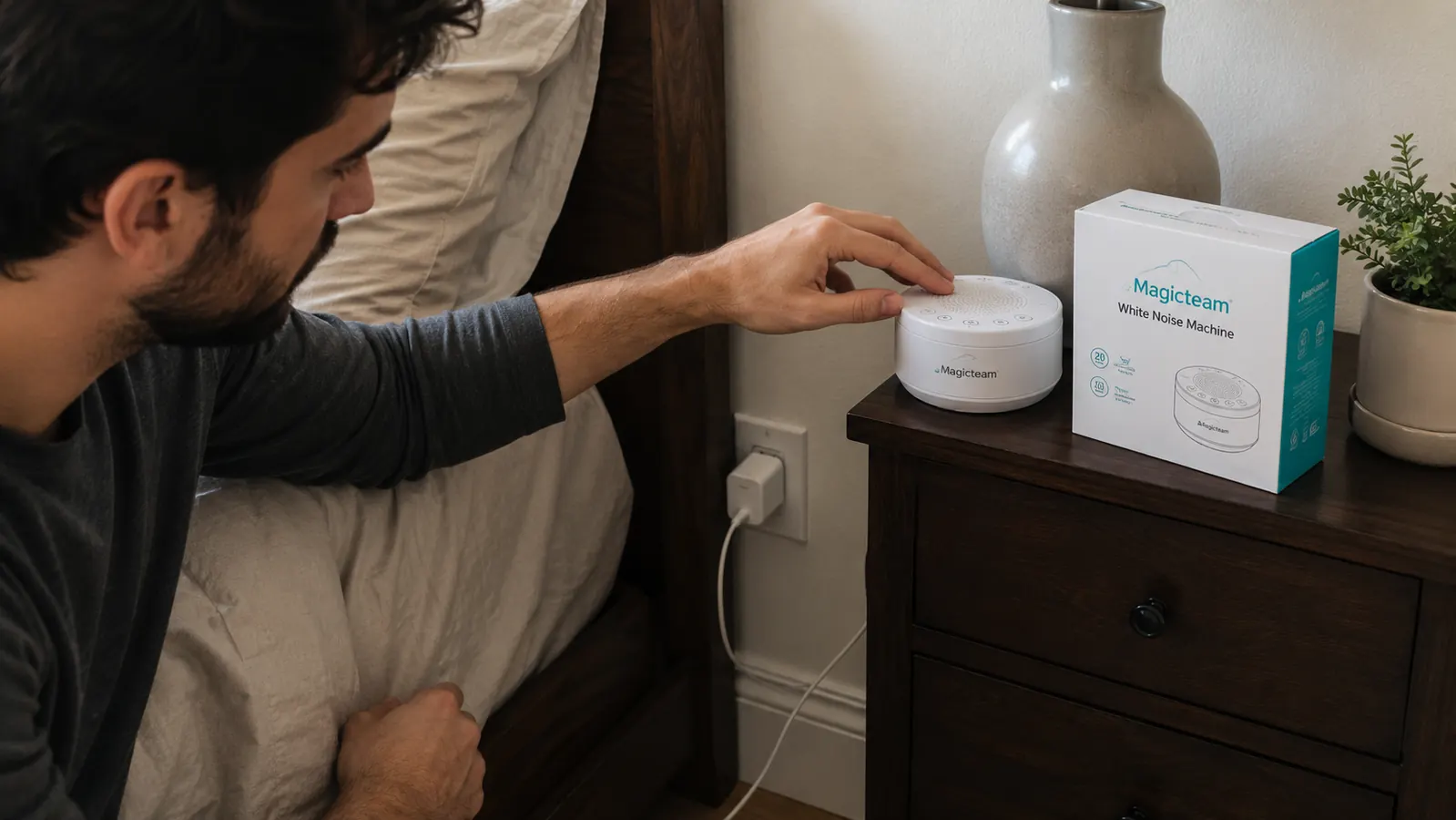
The plastic housing is lighter than it looks in photos, and after close to a year of being unplugged and moved most afternoons when I need that outlet for something else, the finish around the dial has picked up a faint sheen from repeated handling. Nothing has broken. Nothing rattles when it's sitting still. But at higher volumes on certain sounds, particularly anything with a low bass component, I can feel a very slight vibration in the casing itself if I rest a hand on top of it, which tells you something about how thin the shell actually is compared to what the weight in your hand suggests when you first pick it up.
The printed labels around the buttons have also started to fade slightly with a year of thumb contact, mostly on the power button, which I press daily. It's cosmetic, not functional, but it's another one of those small honesty points: this is a budget device built to a budget price, and it shows in the details rather than in whether it actually does its core job.
What I Liked
- Genuinely effective masking sound for steady daytime traffic once you find the right volume
- Memory function means you rarely have to fuss with settings once you've found your favorite
- 18 of the 20 sounds are truly non-looping, holding up even to stopwatch testing
- Battery option works as a real backup during power outages
- Affordable enough that the rough edges are easier to accept than they'd be on a premium device
Where It Falls Short
- Indicator light doesn't fully turn off and has no disable option
- Included power adapter can introduce a faint electrical buzz depending on your outlet and circuit
- Volume dial moves in noticeable steps rather than a smooth gradient, so your ideal setting may fall between two stops
- A couple of the nature sounds do have an audible loop point on close, critical listening
- No sound names displayed on the device itself, just numbers, until you memorize them
It took me most of a year to notice the light, the buzz, and the loop points, not because they're rare, but because they only show up once you've stopped being grateful the noise finally stopped and started actually listening.
Who This Is For
If your main problem is steady daytime traffic or household noise and you're willing to spend ten minutes finding the right outlet and settling on two or three favorite sounds, the rough edges here are easy to live with. It's especially worth it if you already sleep in a room that isn't fully dark to begin with, since the indicator light barely registers against real daylight. Anyone who wants a simple, dial-and-plug device without an app or a subscription will likely find these annoyances minor compared to what the machine actually does for masking sound.
Who Should Skip It
If you're specifically protecting a fully dark room and even a small blue light would bother you, or if you're sensitive to any electrical hum and don't want to troubleshoot outlets to eliminate it, look elsewhere or budget time to test your specific setup before you rely on it. Same goes if precise, repeatable volume control matters more to you than price, since the stepped dial won't give you the exact granularity a digital display and buttons would.
Now you know what the five-star average doesn't say
None of this stopped me from running the Magicteam Sound White Noise Machine every single day for the better part of a year. See today's price on Amazon and go in with eyes open about the small stuff.
Amazon Check Today's Price on Amazon →