
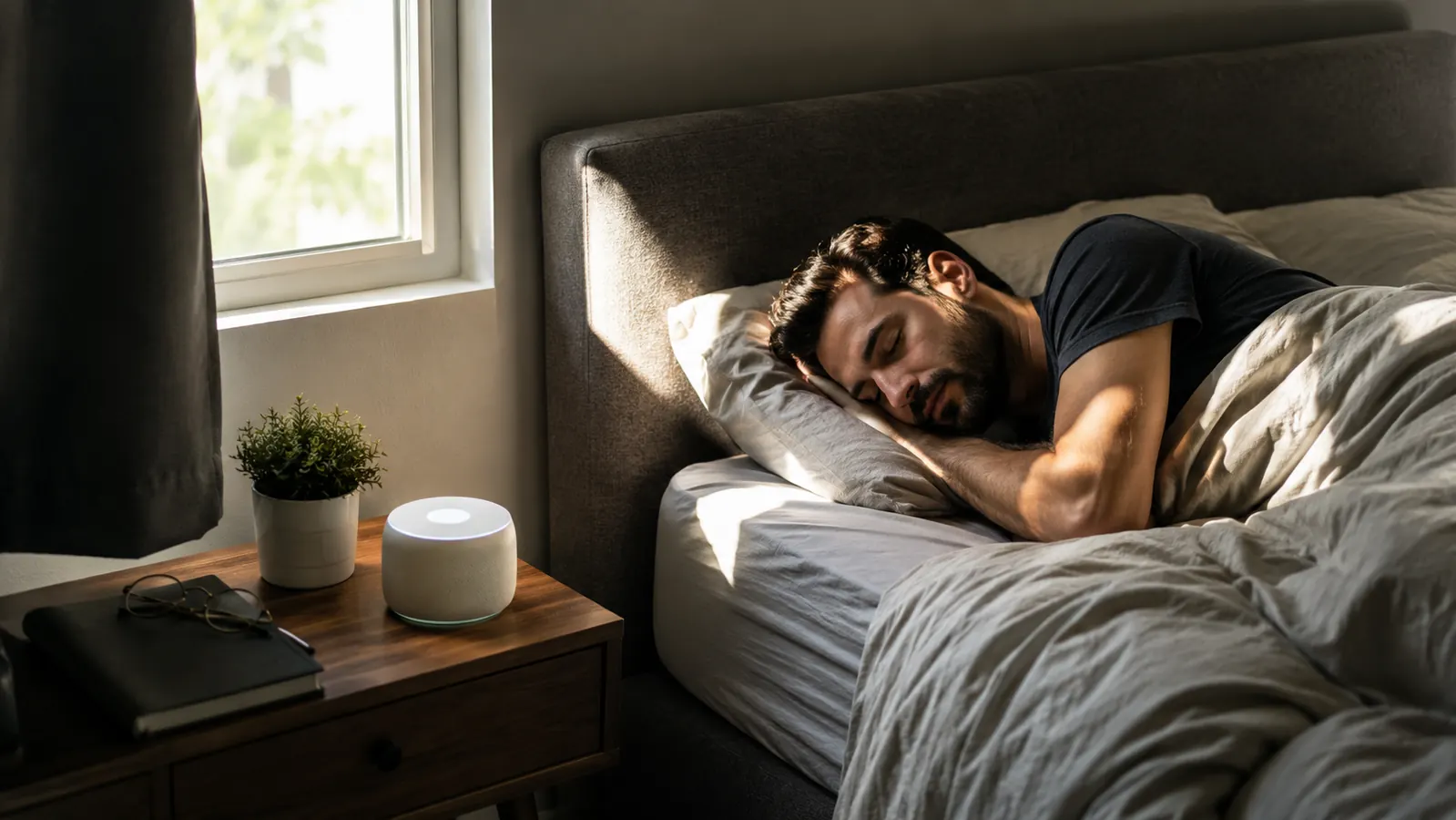
For eleven years I produced an overnight radio show, which meant my workday ended around the time most people's started. I'd get home a little after 8am, and by 9am I needed to be asleep in a west-facing second-floor bedroom where the afternoon sun comes straight through the window and the street below runs full daytime traffic. Trucks, delivery vans, kids walking to school, a neighbor's landscaping crew on Tuesdays. None of that noise cares that I'm trying to sleep at 11am instead of 11pm, and for the first couple of years on that schedule I basically never slept a full stretch without waking up at least twice.
I tried earplugs first. They helped with the sharp stuff (car doors, dog barks) but did nothing for the low rumble of traffic that just sits under everything. I also tried a box fan, a phone app, and a set of cheap foam plugs from a drugstore rack, none of which held up past the first couple of weeks. What actually changed my daytime sleep was learning to run a white noise machine correctly, not just switching one on and hoping. I've been using a Magicteam Sound White Noise Machine on my nightstand for months, and the five steps below are the exact process I used to go from 'this thing is just background noise I ignore' to actually masking the traffic outside my window.
The machine that finally masked my street noise, not just added to it
The Magicteam has 20 non-looping sounds, real volume range, and a memory function that saves your exact setting overnight. That combination is what made the difference for me. See today's price and current availability on Amazon.
Amazon Check Today's Price on Amazon →Step 1: Identify What Noise You're Actually Fighting
Before you touch a volume dial, figure out what's actually keeping you up. My problem was almost entirely low-frequency: engine noise, tires on asphalt, the occasional bus brake. That's different from a snoring partner, a barking dog, or thin apartment walls carrying a neighbor's TV. Each of those has a different frequency profile, and white noise machines don't mask everything equally well, so the first mistake most people make is buying a machine before they've named the problem it needs to solve.
Spend one night just listening. Lie in bed with the lights off (or blackout curtains drawn, since I'm dealing with full daylight) and mentally log what wakes you or keeps pulling your attention. Is it a steady rumble, or sharp, unpredictable sounds? Does it come in waves at predictable times, like a school bus route or a garbage truck on Thursdays, or is it random all day long? That answer decides which sound profile you'll reach for in Step 2.
In my case, it was steady low rumble with the occasional sharp spike (a delivery truck's back-up beeper, mostly). That meant I needed a sound that had enough low-end body to cover the rumble, with enough overall presence to blunt the spikes too. Traffic noise is one of the hardest categories to mask because it's broadband. It doesn't sit neatly in one frequency range the way, say, a dripping faucet or a humming refrigerator does, which is exactly why a lot of people give up on white noise machines after trying just one preset and assuming that's all the device can do.
Step 2: Choose the Right Sound Profile, Not Just "White Noise"
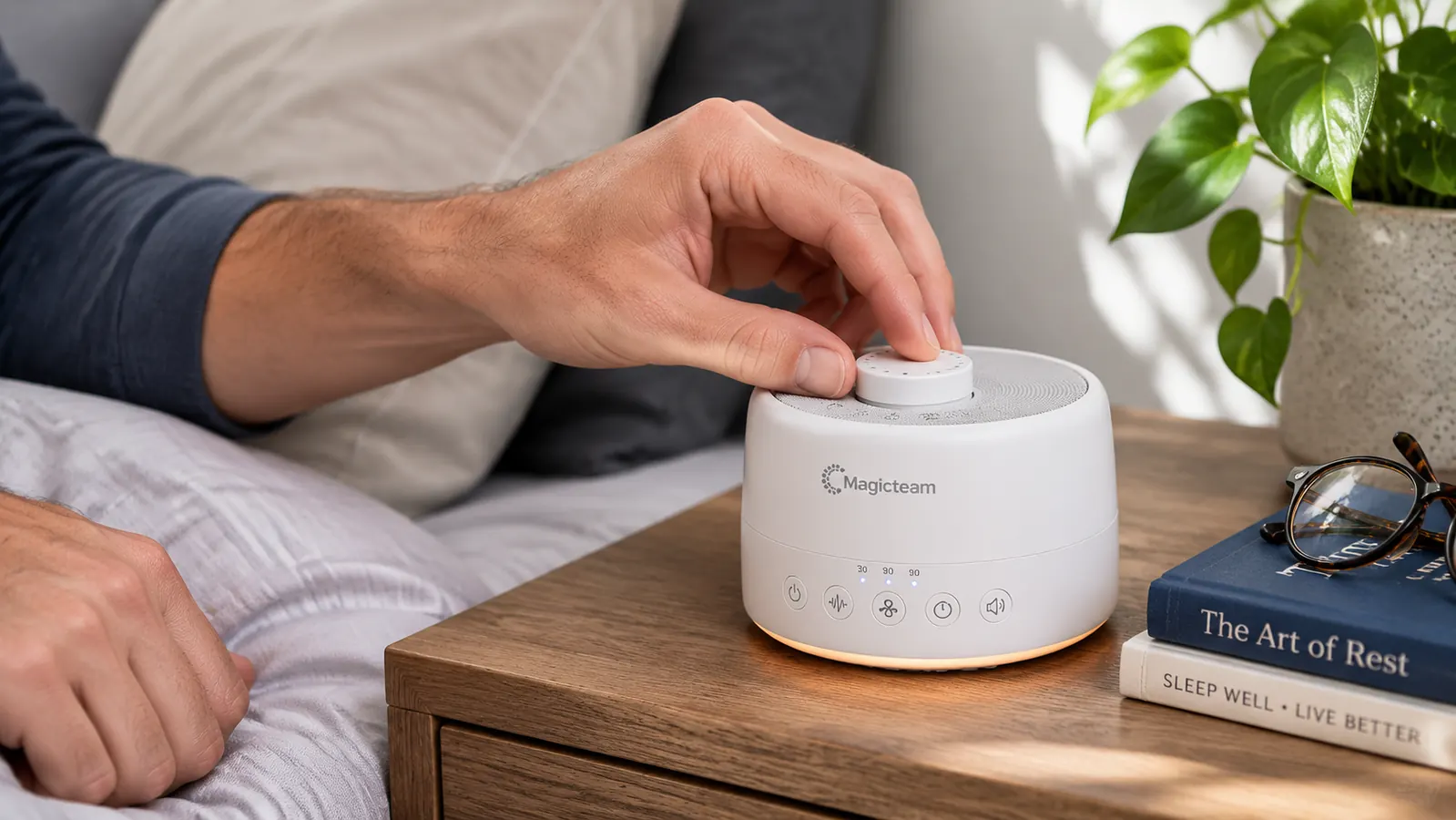
This is the step most people skip, and it's the one that matters most. "White noise machine" is a category name, not a single sound. The Magicteam I use has 20 built-in options, and I tested most of them over the course of about two weeks before landing on the two I actually rely on: a straight white noise setting and a deep fan sound. Both have more low-frequency energy than the ocean or rain sounds, which I found too airy to cover traffic rumble, even at a higher volume.
If your problem is a snoring partner or voices through a wall, brown noise or a fan sound tends to work better than white noise, because it has more weight in the lower register where snoring and speech sit. If your problem is a barking dog or sudden clatter, you actually want something with more presence across the whole range, which is closer to true white noise or static. Rain and ocean sounds, in my experience, work best for people whose main issue is a racing mind rather than an external noise source, since those tracks are pleasant to listen to but thinner in the low end.
One thing I appreciate about the Magicteam specifically is that the sounds are non-looping. A lot of cheaper machines cycle through a short clip, and after a few nights your brain starts to notice the loop point, which defeats the purpose. A noticeable loop is almost worse than no white noise at all, because it becomes its own attention hook, the exact opposite of what you're trying to achieve when the whole point is to stop noticing sound.
Step 3: Get the Volume and Placement Right
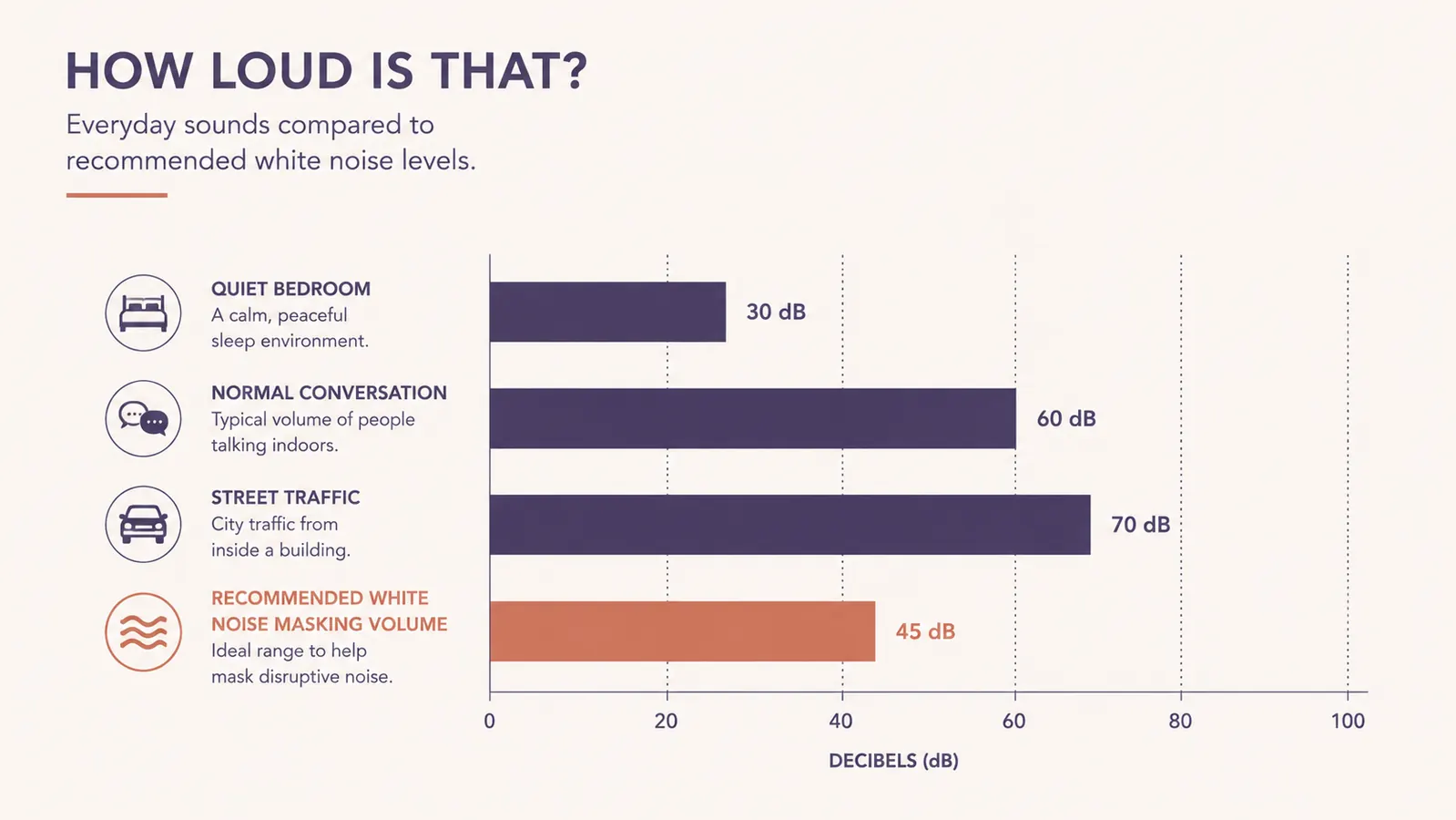
Masking noise is about exceeding the volume of what you're trying to cover, not just adding sound on top of it. If your street noise averages somewhere around 55 to 65 decibels (a rough range for moderate daytime traffic), your white noise machine needs to sit above that, consistently, not just at its peaks. Too many people run their machine at a comfortable, quiet volume and wonder why it isn't working. Comfortable and effective are not the same setting, and figuring that out is what finally got me a full stretch of daytime sleep instead of the broken two-hour naps I'd been settling for.
Placement matters almost as much as volume. I keep mine on the nightstand, roughly two feet from my head, rather than across the room on a dresser. The closer the machine is to your ears, the less overall volume you need to achieve the same masking effect, which also means less strain on the speaker and a more even sound rather than something that feels like it's blasting from one corner of the room while the rest of the space stays quiet.
Start louder than feels natural for the first few nights. Your ears adjust to a consistent sound faster than you'd expect, and what feels like too much on night one usually feels normal by night four. If it still feels harsh after a week, that's a sign to switch sound profiles rather than just turning the volume down and losing the masking effect you actually need.
Step 4: Use the Memory Function to Remove Decision Fatigue
Once you've found your sound and volume, the goal is to never think about it again. This is where the Magicteam's memory function earns its keep. It saves your exact sound and volume setting, so every night is a single button press instead of relearning the dial from scratch. That sounds small, but decision fatigue at bedtime is real, especially if you're already fighting your body's instinct that it's the wrong time of day to sleep, which is exactly the fight I'm having every single morning when I get home from an overnight shift.
I also set mine to run continuously rather than on a sleep timer. Machines that shut off after 60 or 90 minutes work fine for someone who falls asleep quickly and stays asleep, but for daytime sleeping, where your body is already working against its own clock, losing the masking noise partway through can wake you right back up just as the traffic outside picks up for lunch hour. If your machine has a timer option, I'd suggest testing continuous mode first and only switching to a timer if you have a specific reason to.
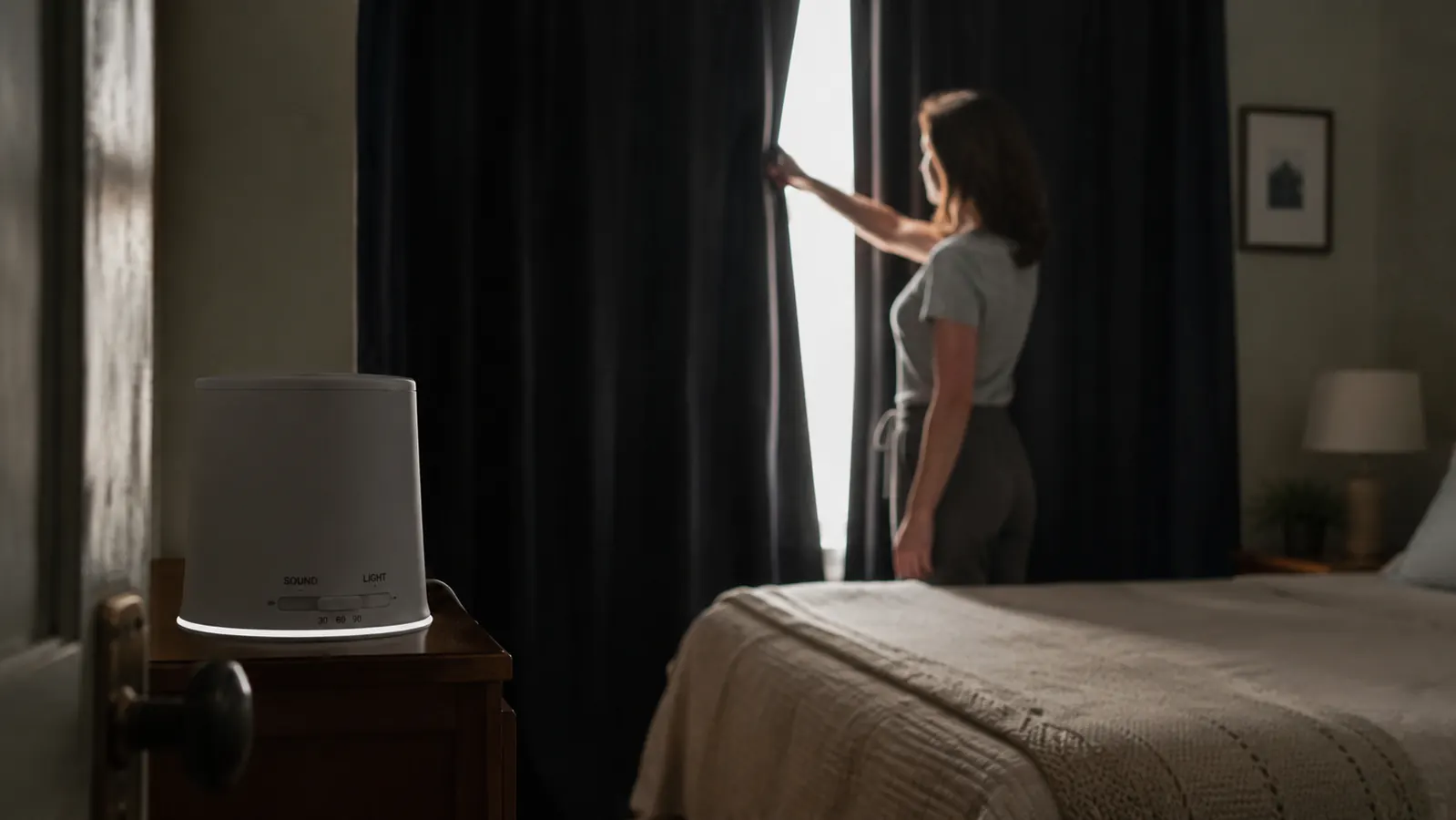
Build a short, boring routine around it: curtains, machine on, same volume, same sound, every single day. Boring is the goal. Your brain reads repetition as a signal that it's time to sleep, the same way a lullaby works for a toddler, minus the singing. It took me roughly three weeks of doing this exact sequence before my body stopped treating 9am as an obviously wrong time to close my eyes.
Step 5: Layer It With Light Control, Because Sound Alone Isn't Enough
A white noise machine solves the noise half of the problem. If you're sleeping during daylight hours like I do, or in a room with streetlights or early sunrise, sound masking alone won't get you all the way there. Blackout curtains or a sleep mask handle the light side, and the two together do more than either does alone. For a fuller rundown on why the combination matters so much, I wrote about it in 10 reasons a white noise machine actually improves sleep, including a few reasons that surprised me when I first started digging into the research on masking and sleep architecture.
I keep a set of blackout curtains on my west-facing window and a spare eye mask in my nightstand drawer for the days the sun is especially aggressive (spring and early summer, mostly, when the afternoon light comes in at exactly the wrong angle). Neither replaces the white noise machine. They solve a different problem. But treating sleep like a single-fix situation, one gadget solves everything, is the mistake I made for the first year or two of overnight shifts before I figured out that light and sound need separate solutions running at the same time, not one product doing double duty.
What Else Helps
A fan running in the background can do a rougher version of the same job as a white noise machine, and it's worth trying if you already own one before spending money on a dedicated device. The tradeoff is that a fan gives you one sound at one volume, with no sound library, no memory function, and airflow you may not want in a cold room in the winter months. A dedicated machine gives you control over the actual frequency profile, which matters more than most people expect until they've tried switching from rain sounds to a deep fan setting and noticed the difference themselves on a night the traffic outside is worse than usual.
Earplugs are a reasonable backup for the nights your masking setup still isn't quite enough, particularly for sharp, unpredictable sounds like a slamming car door or a dog's sudden bark. I keep a pair in the drawer but rarely need them anymore, mostly because the machine handles the steady rumble that used to be the real problem, and it's the steady stuff that wears you down over weeks, not the occasional spike that only happens once or twice a day.
The fix wasn't turning on a white noise machine. It was learning which sound, at which volume, in which spot on the nightstand, actually covered my specific noise. Everything else was just background hum I'd stopped paying attention to for the wrong reasons.
Start with the sound, not the guesswork
If you're rebuilding your setup from scratch, the Magicteam gives you the range to test sound profiles until you find the one that actually masks your noise, plus the memory function to lock it in once you do. Check today's price and current availability on Amazon.
Amazon Check Today's Price on Amazon →